
Chapter 27: AI Adoption & Engineering Leadership
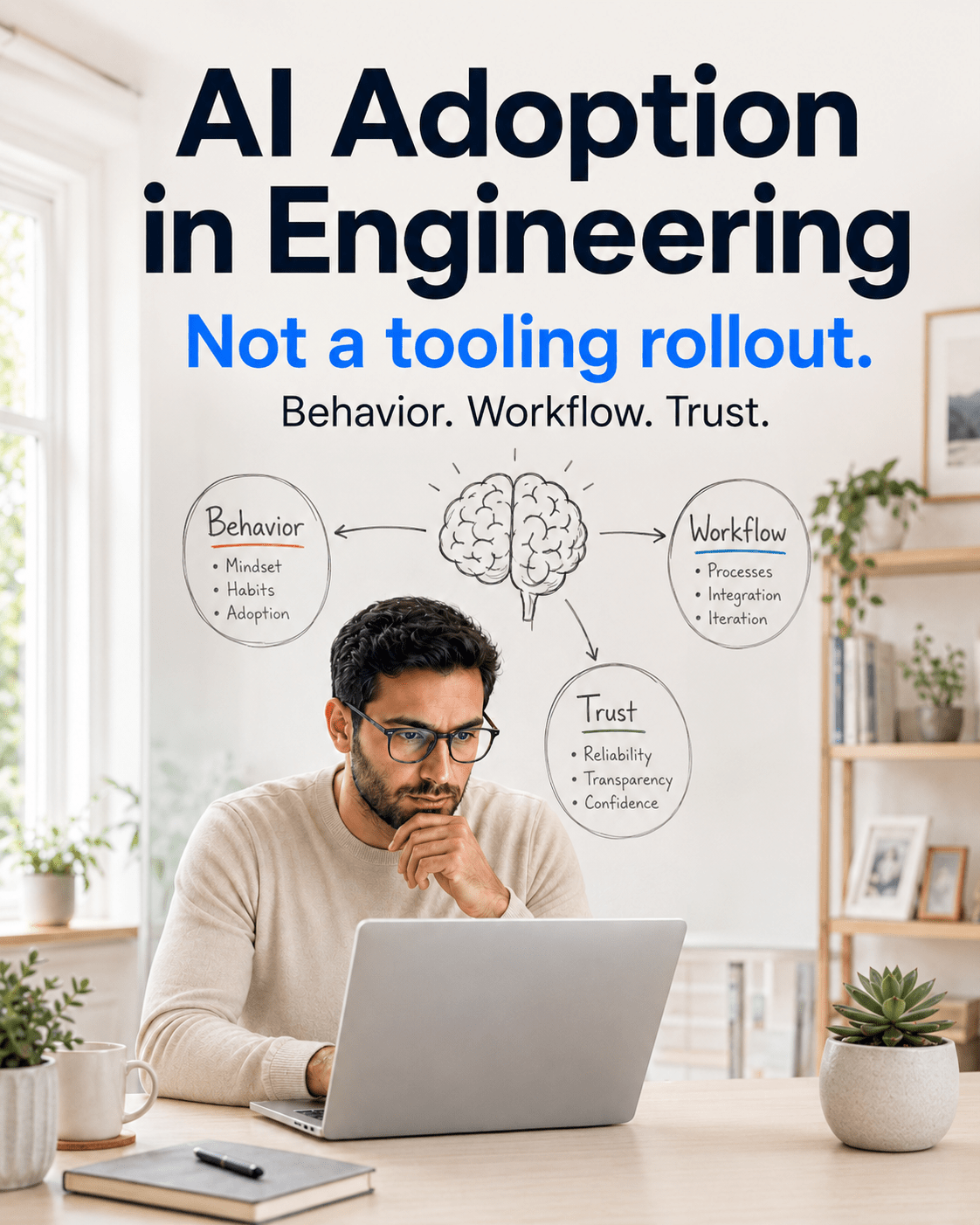
Adoption Is a Behavior Change, Not a Tooling Rollout
Increasing AI adoption is not about buying more tools. It is about removing the friction between "I should try this" and "this actually helps me ship better software." Most teams do not have an adoption problem because engineers are resistant. They have an adoption problem because leadership rolls out AI like a corporate wellness program. Here is what actually works.
1. Start with real engineering pain. Do not lead with "here is our AI strategy." Lead with: where are we losing time? Where are reviews slow? Where do tests break trust? Where does onboarding hurt? Adoption starts where pain already has budget.
2. Make it part of the workflow. If engineers must leave their IDE, context switch, paste code into five tools, and reconcile output by hand, adoption dies. The best AI tooling feels like infrastructure, not homework - it lives inside the SDLC as a pipeline stage, not a demo.
3. Create guardrails, not handcuffs. Engineers need clear rules: what data can be used, what tools are approved, what requires review, what cannot be trusted, what must be verified before merge. The goal is not "move fast and hallucinate things." It is "move faster with evidence."
4. Measure outcomes, not vibes. Adoption is not measured by license count. Measure cycle time, review speed, coverage, escaped defects, onboarding time, incident triage speed, and developer flow. If the metric is "we bought 200 seats," congratulations - procurement had a sprint.
5. Let engineers lead the patterns. The best adoption comes from internal champions building repeatable examples: prompt libraries, review patterns, test-generation flows, architecture checklists, and team demos that show real before-and-after results. Engineers trust working software.
6. Treat skepticism as a feature. A skeptical engineer is not blocking progress - they are protecting production. Bring them in early, let them test the limits and find the sharp edges, then use that feedback to make adoption safer and more useful.
Roll It Out in Deliberate Waves
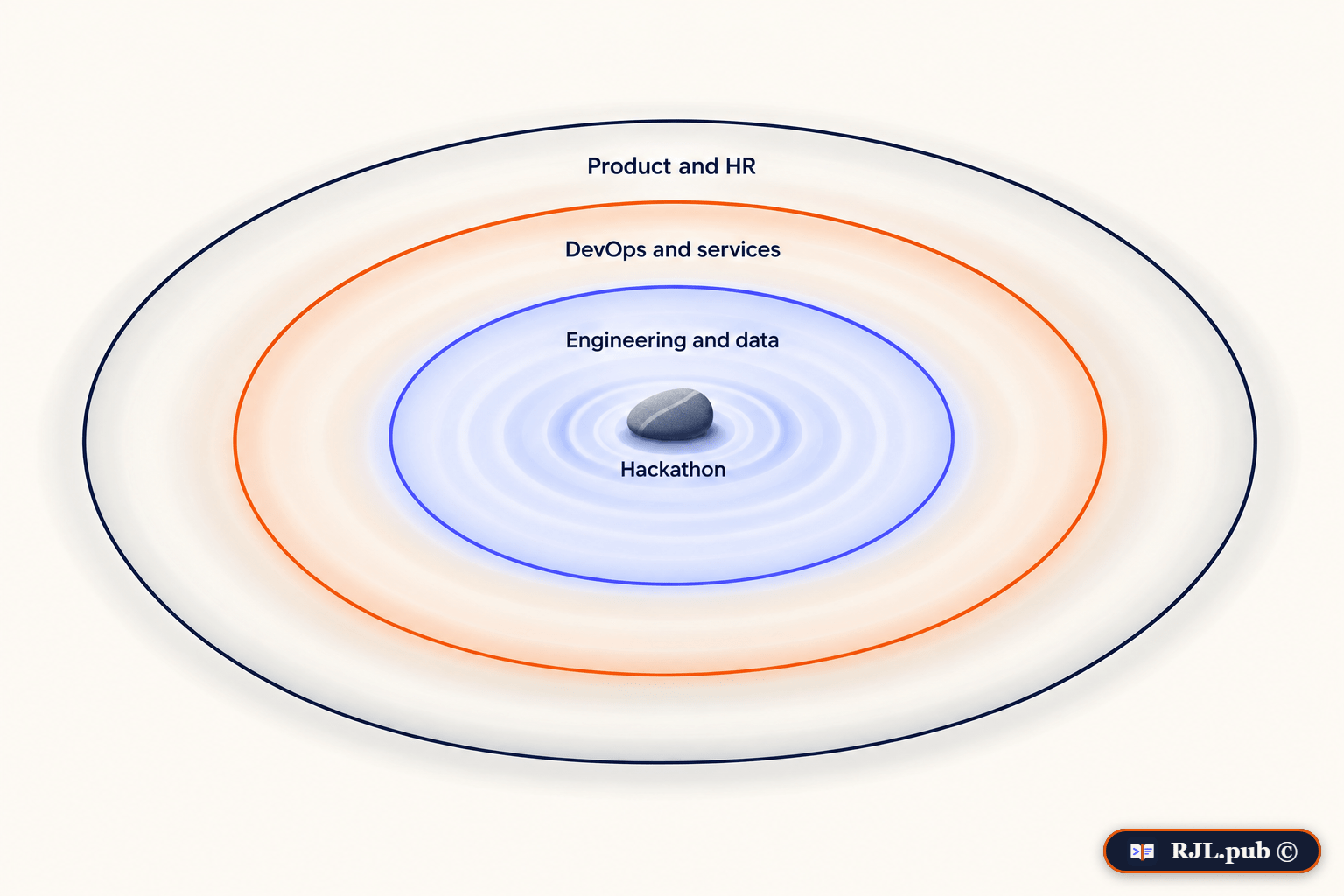
A whole-company "everyone use AI now" mandate fails. What works is deliberate waves. At the Medical SaaS Company I moved the organization from "AI-curious" to "AI-proficient" one group at a time: engineering and data first, then DevOps, integrations, and professional services, then product and HR. Each wave learned from the last and built the patterns the next would inherit. A few mechanisms did the heavy lifting:
* A hackathon as an organizational rock. Explicit permission for engineers to step off the sprint, attack a real problem, and stress-test the toolkit - the fastest way to convert curiosity into conviction.
* Rolling Show and Tell sessions that turned individual experiments into shared playbooks, so a win on one team did not stay on one team.
* A shared knowledge hub and prompt library capturing the workflows that worked, so patterns compounded instead of being rediscovered.
* An AI literacy program making baseline fluency - what these tools do, and where they fail - a shared competency rather than a specialist skill.
* Internal champions building the repeatable recipes: code-review flows, test-generation patterns, secure-coding assistants.
Throughput of AI-assisted work was tracked as a leading indicator alongside delivery and quality metrics - not as a vanity number, but as an early signal of whether a wave was actually landing.
Adoption Beyond Engineering: Partnering with Product and the CPO
The highest-ROI AI adoption crosses the line out of engineering. The transformation that sticks reaches Product, Operations, Finance, and HR - and the most important partnership is with the Chief Product Officer. At the Medical SaaS Company I partnered with the CPO on product strategy, including a gap analysis that drove a multi-phase roadmap with AI at the core of both flagship initiatives. That partnership changed what got built, not just how fast it shipped.
Two patterns matter most when adopting AI with product leadership. First, a fail-fast research-and-development model: partner with product leaders and customers to validate ideas quickly, ship MVP solutions on compressed cycles, and identify which capabilities deserve broader investment - which cuts wasted engineering effort and improves the quality of the customer signal. Second, give product teams their own AI leverage: rapid-prototyping tools like Bolt and Lovable let a CPO and product team turn a concept into something clickable in hours, which engineering then hardens for production. The handoff is clean because the prototype, like a spec, becomes a shared source of truth. AI adoption that stops at the engineering org captures a fraction of the value; the rest is unlocked when product and engineering move at the same speed.
The Risk Is Rarely the Model
The blocker to adoption is rarely the model. It is the gap between an engineer's perceived risk and the actual risk. Senior engineers protect quality by default; that instinct is a feature, not a bug. A leader's job is not to override it - it is to recalibrate it with evidence, then champion the ideas those engineers were already trying to push through. You do not accelerate adoption by being louder. You do it by being the first one in the water, and by asking the question that makes the cost of waiting visible: if the downside is this small, what exactly are we protecting by waiting?
You do not accelerate adoption by being louder. You do it by showing the work. Open the PR. Walk through the tradeoffs. Show where the tool helped and where judgment still mattered. Make the risk visible - then ask the question that makes the cost of waiting impossible to ignore: what risk are your best engineers actually managing? When I did exactly this with a cautious, senior architect - real code, real PRs, real tradeoffs, not a vendor demo on a codebase with no trauma - he went from a few parked experiments to using AI to pressure-test service boundaries, map legacy coupling, and turn vague architecture concerns into smaller, safer decisions the team could act on. He later described his own AI journey in two phases: before that shift, and after it.

The Leadership Discipline
Intent engineering, governance, and adoption are leadership disciplines, not just individual-contributor skills. The most valuable thing a leader does is the judgment call on where AI earns its keep and where it actively makes things worse. That call is sound when it comes from someone who still writes code and reviews PRs, tracks the frontier models with real evaluations, and measures shipping velocity and reliability rather than the appearance of work. AI that ships, not AI theater.