
Chapter 6: GitHub Copilot & Alternatives
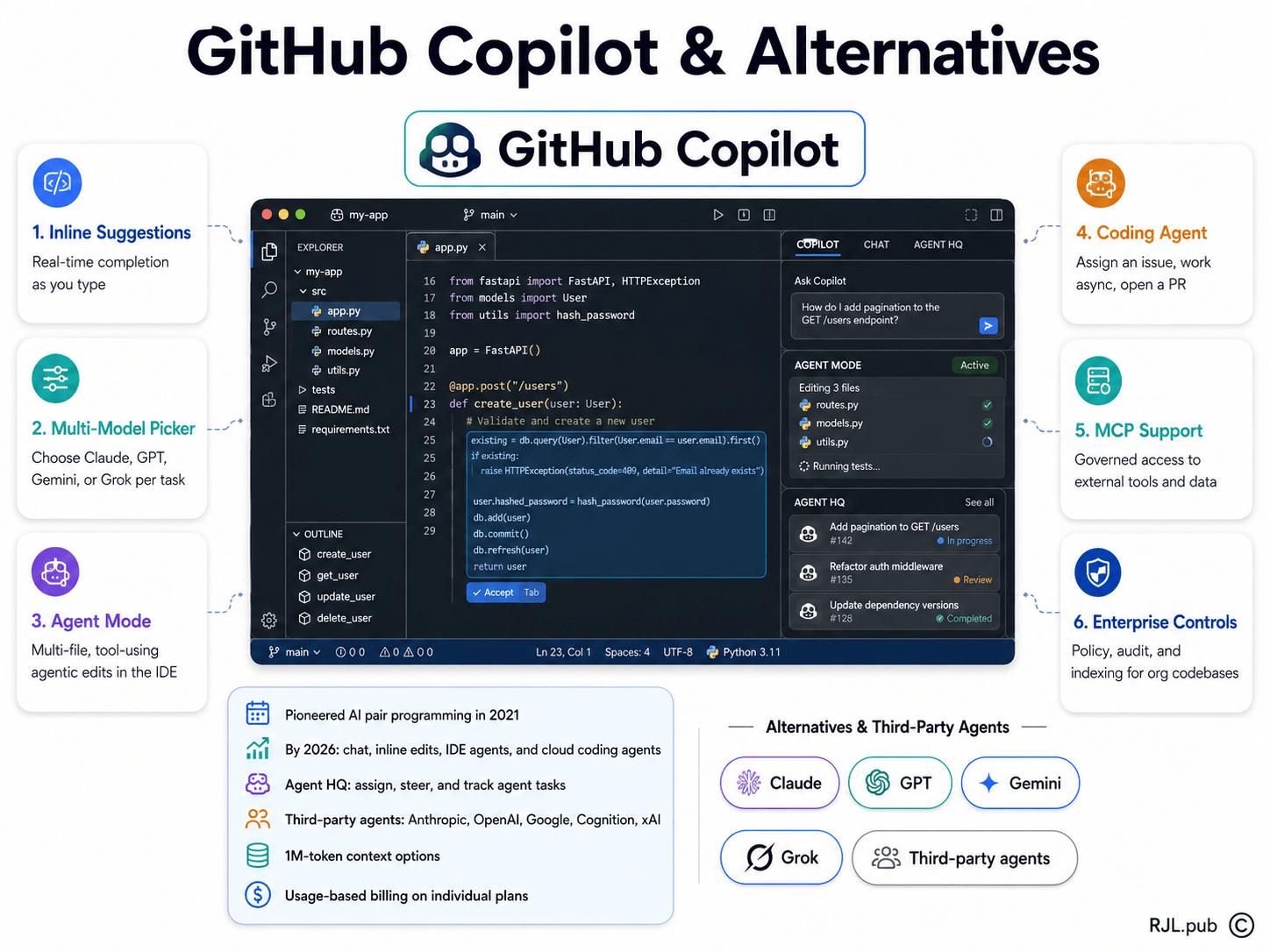
GitHub Copilot
GitHub Copilot pioneered AI pair programming in 2021 and remains the most widely adopted AI coding assistant, used by tens of millions of developers. It long since outgrew autocomplete. By 2026 Copilot offers chat, inline edits, an agent mode inside VS Code and JetBrains, and a cloud coding agent you can assign GitHub issues to - it works in its own environment and opens a pull request for review. Agent HQ turned that into mission control: assign, steer, and track agent tasks across GitHub, VS Code, and the CLI, with third-party agents - Anthropic, OpenAI, Google, Cognition, xAI - running inside the same Copilot subscription. Mid-2026 also brought 1M-token context options and a move to usage-based billing on individual plans, part of an industry-wide retreat from flat unlimited tiers.
Key Features:
* Inline Suggestions: real-time completion as you type
* Multi-Model Picker: choose among Claude, GPT, Gemini, and Grok models per task
* Agent Mode: multi-file, tool-using agentic edits in the IDE
* Coding Agent: assign an issue; Copilot works async and opens a PR
* MCP Support: governed access to external tools and data
* Enterprise Controls: policy, audit, and indexing for org codebases
Effective Copilot Usage
Inline Completion Best Practices:
// Good: Descriptive comment with context
// Validate email format using RFC 5322; return true if valid
function validateEmail(email) {
  // Copilot generates accurate, intent-aligned validation
}

// Poor: Vague comment
// email function
function validateEmail(email) {
  // Copilot generates generic, possibly incorrect code
}
The 2026 Tool Landscape
The field is crowded and converging on agentic capability. Alternatives and complements include:
OpenAI Codex - agentic coding in the CLI, IDE, desktop, and cloud on OpenAI's current GPT line; folded into the unified ChatGPT app in mid-2026, with a dedicated app-sec agent (Codex Security)
Claude Code - terminal, IDE, desktop, and cloud agent with subagents, Skills, Routines, and self-hosted cloud runners
Cursor - agent-first IDE with in-house Composer models; acquired by SpaceX for $60B in 2026, now a SpaceXAI product alongside Grok
Google Antigravity and Jules - Google's agent platform (IDE, CLI, and SDK; it replaced the retired Gemini CLI in mid-2026) and the async cloud agent; by late 2026 Antigravity also reaches into existing editors through extensions rather than living only in its own app
SpaceXAI Grok Build and Grok Bot - terminal coding agent and always-on cloud agents on the Grok 4.x line; the Grok Build harness itself is open source under Apache 2.0 and can be pointed at other endpoints
AWS Kiro - spec-driven agentic IDE (the successor to Amazon Q Developer's direction, which is being wound down)
Devin - Cognition's autonomous engineer for delegated, async tasks; it absorbed Windsurf, which relaunched as Devin Desktop
Meta Muse Code - a terminal coding agent from Meta's Superintelligence Labs, in beta since mid-2026, notable mainly for putting a fourth large lab in the coding-agent market
Cline, Aider, and OpenHands - the open-source, multi-provider agent layer
Bolt and Lovable - rapid app and prototype scaffolding for product and engineering teams
Two structural notes on that list. First, the harness is separating from the model: Grok Build is open source, Cline and OpenHands were always multi-provider, and ACP (Chapter 8) lets one editor host agents from several vendors at once. The harness you learn is increasingly not the vendor you buy from. Read the license and the contribution policy as two separate questions, though. Grok Build ships under Apache 2.0, but its own repository states plainly that it does not accept external pull requests or unsolicited patches. That is open source as transparency rather than open source as collaboration: you can read it, fork it, and point it at another endpoint, which is most of what portability actually needs - but you cannot shape it, and a fork you maintain alone is a cost, not a hedge. When a vendor open-sources its harness, check which of those two things you are being given. Second, the free and included tiers are the least stable part of any of these products - allowances have been cut, promotional pricing has lapsed, and free CLIs have been retired outright. Evaluate on the paid behavior you would actually depend on, not the trial.
Tool Comparison Matrix
Capability          | Copilot | Claude Code | Cursor | Codex
--------------------|---------|-------------|--------|------
Inline Complete     |   YES   |   partial   |  YES   | partial
Multi-file Agent    |   YES   |     YES     |  YES   |  YES
Async Cloud Agent   |   YES   |     YES     |  YES   |  YES
Subagents/Parallel  | partial |     YES     |  YES   |  YES
MCP Support         |   YES   |     YES     |  YES   |  YES
Max Context         |  large  |     1M      | large  | large
Multi-model         |   YES   |   Claude    |  YES   |  GPT
The practical answer is rarely one tool. Most strong teams run a deliberate multi-model strategy - Copilot for in-IDE flow, Claude Code for orchestration and large refactors, Codex and Gemini for specific strengths - so engineers build fluency across providers and no single vendor's price hike or bad release holds the roadmap hostage.