Chapter 29: Emerging Patterns
Spec-Driven Development. Tools like AWS Kiro and open spec-driven workflows turn a written specification into the source of truth: the spec generates tasks, the agent implements them, and the spec is what review and evals check against. Intent specs are the production-grade version of this idea.
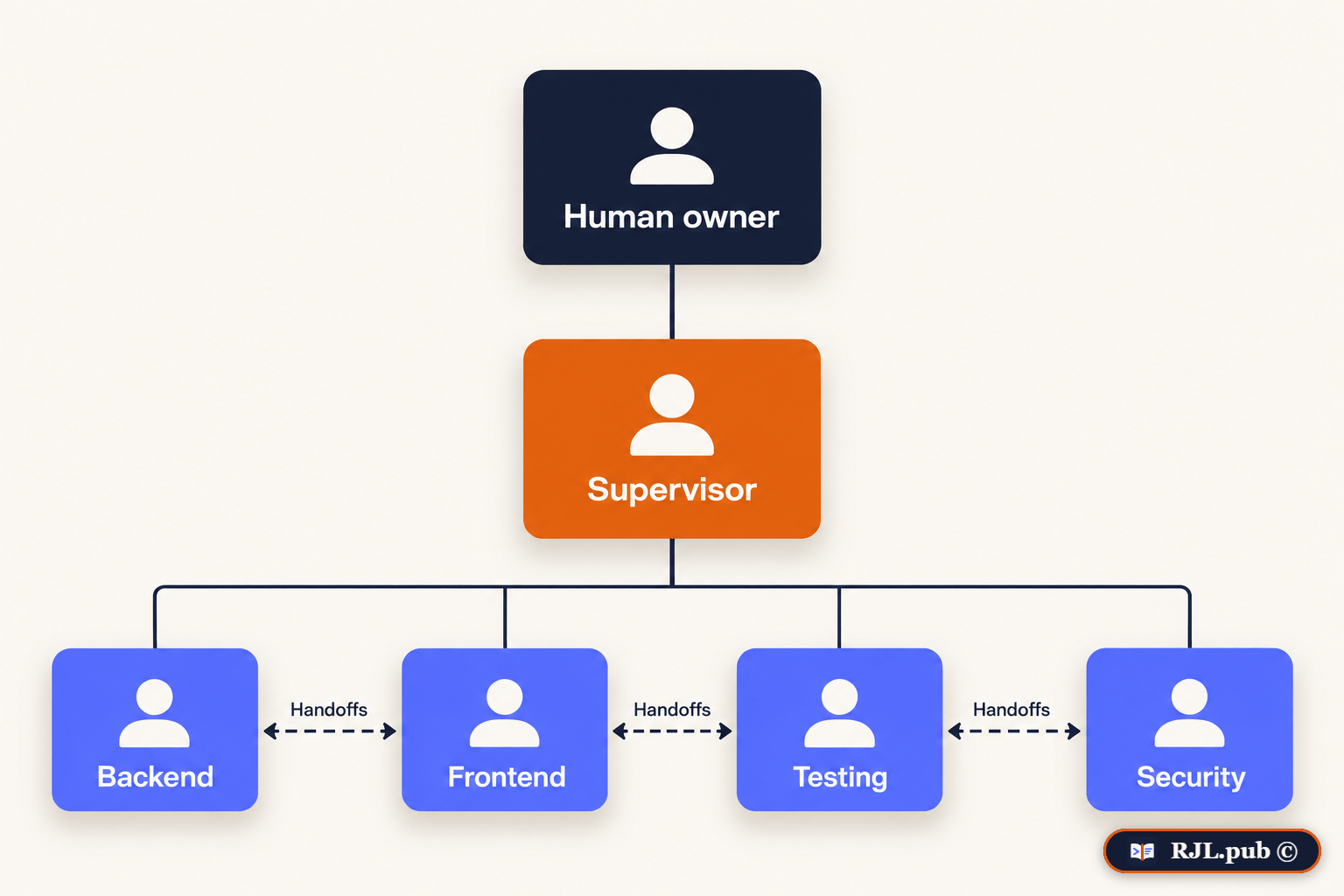
Multi-Agent Teams. Specialized agents - backend, frontend, testing, security - collaborate through A2A handoffs under a supervising agent, with a human owning the outcome. Orchestration frameworks make these teams reproducible rather than bespoke.
Agent Skills and Reusable Capabilities. Packaging reusable instructions, scripts, and resources as Skills lets an organization encode its conventions once and have every agent invoke them on demand - context and capability versioned together. Skills became an open standard published at agentskills.io, supported across dozens of products by mid-2026 - write a skill once and Claude, Codex, Copilot, and Cursor can all run it. Watch the governance split, though: MCP, AGENTS.md, and A2A now sit under the Linux Foundation's Agentic AI Foundation, while the Agent Skills format is maintained by Anthropic in the open rather than by a neutral body. An open format and neutral governance are not the same thing, and the difference is worth knowing before you bet a platform on a standard.
Ambient, Always-On Agents. Scheduled routines, event-subscribed cloud agents, and standing agents with their own machines are replacing launch-and-wait tasks (Chapter 15). The unit of adoption is shifting from "a session you drive" to "a fleet you steer" - which makes intent specs, owners, and budgets per agent non-negotiable.
Safety-Gated Capability Tiers. The 2026 frontier decoupled capability from availability: paused releases over cyber thresholds, offensive-security models behind vetted-access programs, and restricted top-tier models with publicly hardened variants. Expect access programs, attestations, and usage audits to become part of AI procurement.
Cloud Development Environments. AI inference, containers, and heavy builds are pushing local machines past their limits. CDEs - Coder, Ona (formerly Gitpod), GitHub Codespaces - move compute-intensive work to remote infrastructure while the IDE stays local. Where the dev environment runs is now a real architectural decision, weighed against compliance posture and cost.
Self-Hosted Open-Weight Models. Frontier open-weight models served on your own infrastructure (for example on vLLM) put capable agents behind your own security boundary - important for regulated data and for cost control at scale.
Evals as a First-Class Artifact. Eval suites are becoming as standard as test suites - versioned, reviewed, and run in CI - because they are the only reliable way to know whether an autonomous workflow is creating value.
Computer Use and Low-Code Force Multipliers. Agents that operate a browser or desktop, plus low-code automation, extend AI beyond the engineering org into operations, finance, and product - the force multiplier reaches the whole company, not just the inbox.