
Chapter 7: Cursor & AI-First IDEs
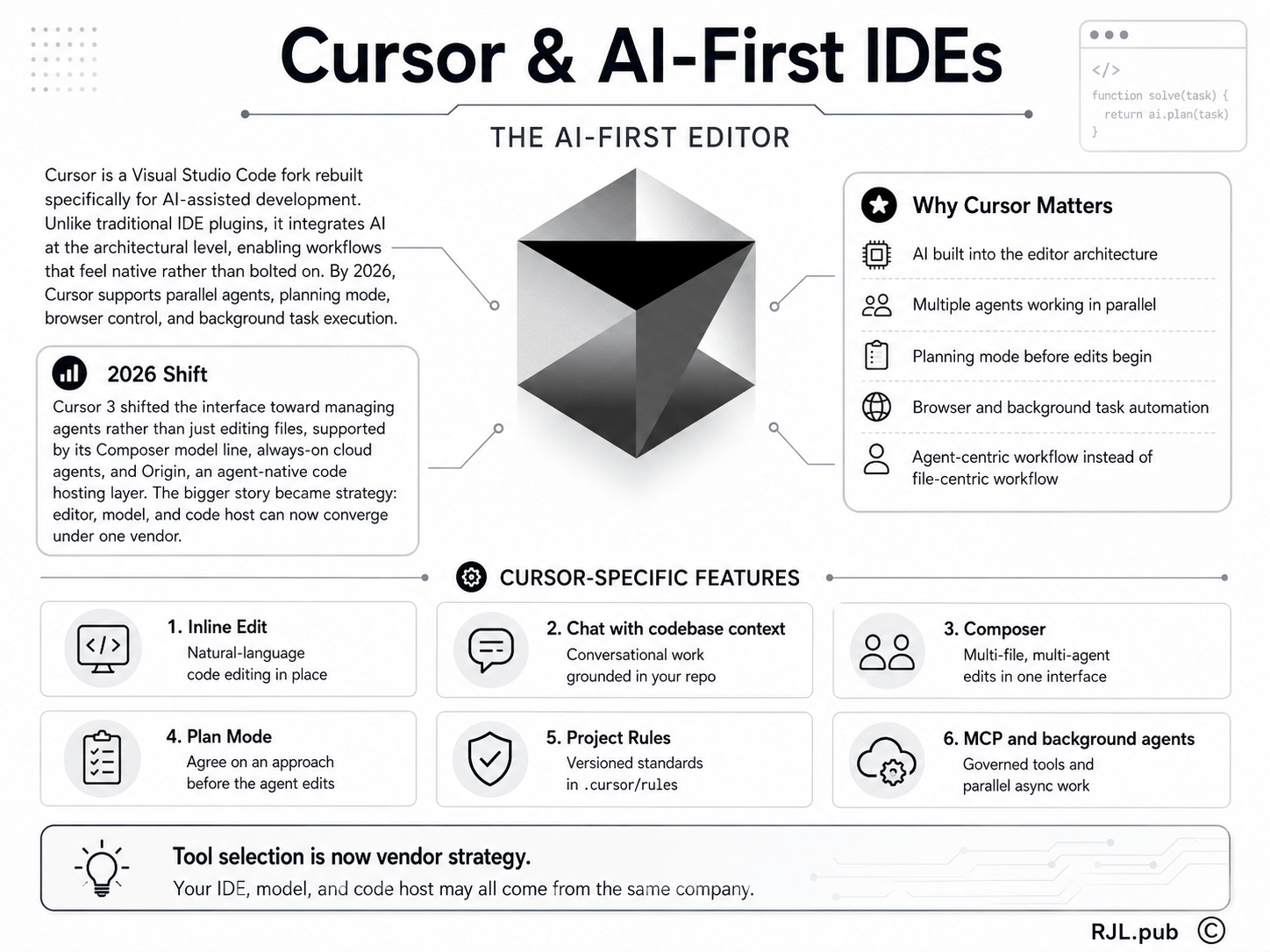
The AI-First Editor
Cursor is a Visual Studio Code fork rebuilt specifically for AI-assisted development. Unlike IDE plugins, Cursor integrates AI at the architectural level, enabling workflows that are awkward in traditional editors. By 2026 Cursor runs multiple agents in parallel, supports a planning mode, and can drive a browser and background tasks. Cursor 3 rebuilt the interface around managing agents rather than editing files, backed by an in-house Composer model line, always-on cloud agents that subscribe to events like PRs and Slack threads, and Origin, its own agent-native code hosting.
The biggest Cursor story of 2026 was ownership, not features: SpaceX acquired Cursor for $60 billion - the largest startup acquisition on record - folding the most popular AI IDE into the same SpaceXAI division that builds Grok. The product now leans toward Grok models by default. None of that makes Cursor a worse editor, but it turned tool selection into vendor strategy overnight: your IDE, your model, and your code host can now all belong to one company. Chapter 9's advice on avoiding single-vendor lock applies to the editor layer too.
The second-order effect arrived faster than anyone expected. In late August 2026, OpenAI invoked a change-of-control clause and notified Cursor's new owner that it would stop serving OpenAI models through Cursor, with a proposed cutoff in November and no new models shipped in the meantime. Anthropic went the other way and publicly committed more capacity to Claude in Cursor. Cursor says OpenAI models were a small share of its traffic, so this is not an outage story - it is a precedent. A model vendor withdrew supply from a tool because of who owned the tool, and every model in that picker is a commercial relationship that can be revoked over something that has nothing to do with your code.
The lesson is not "avoid Cursor." It is that the model picker in any tool is a supply chain, and supply chains get cut for reasons upstream of you. Ask of any AI tool your team standardizes on: if the best model in this picker disappeared next quarter, what would break, and how long would switching take? If the answer is that your prompts, rules files, and workflows are portable, you are fine. If the answer is that the tool is the workflow, you have concentration risk you have not priced.
Cursor-Specific Features:
* Inline Edit: natural-language code editing in place
* Chat with codebase context: conversational work grounded in your repo
* Composer: multi-file, multi-agent edits in a single interface
* Plan Mode: agree on an approach before the agent edits
* Project Rules: versioned standards in .cursor/rules
* MCP and background agents: governed tools and parallel async work
Cursor Rules Configuration
Cursor reads versioned rule files from .cursor/rules/*.mdc (the modern replacement for the single legacy .cursorrules file). Rules can be always-on, auto-attached by file globs, or invoked on demand:
---
description: TypeScript project standards
globs: ["**/*.ts", "**/*.tsx"]
alwaysApply: true
---

# TypeScript Standards
1. Use functional components with hooks, never class components
2. Define prop types with TypeScript interfaces
3. Never use 'any' - use 'unknown' and type guards
4. Prefer composition over inheritance
5. Follow existing patterns in /src/patterns/

# Testing
- Vitest and React Testing Library
- Test user behavior, not implementation
- Mock external API calls

# Style
- Prettier config in .prettierrc
- Max file length: 250 lines
Cursor Composer Workflow
Composer enables complex multi-file changes through natural language, and can run several agents at once:
Prompt: "Add authentication to the API.
Use JWT with 24-hour expiry. Add middleware to
protect routes. Create login and register endpoints.
Add tests for the auth flows."

Composer will:
1. Create /middleware/auth.js with JWT validation
2. Update /routes/*.js to use the middleware
3. Create /controllers/authController.js
4. Generate /tests/auth.test.js with coverage
5. Update package.json with the jsonwebtoken dependency
AI-first IDEs are not the only path - many engineers stay in VS Code or JetBrains with Copilot or Claude Code - but they demonstrate what an editor designed around agents, not files, can do.