Chapter 1: The AI-Assisted Developer
The Paradigm Shift
Software development in 2026 looks nothing like it did in 2022. Production-grade autonomous agents have created a categorical change in how we write, review, debug, and ship code. This is not incremental improvement.
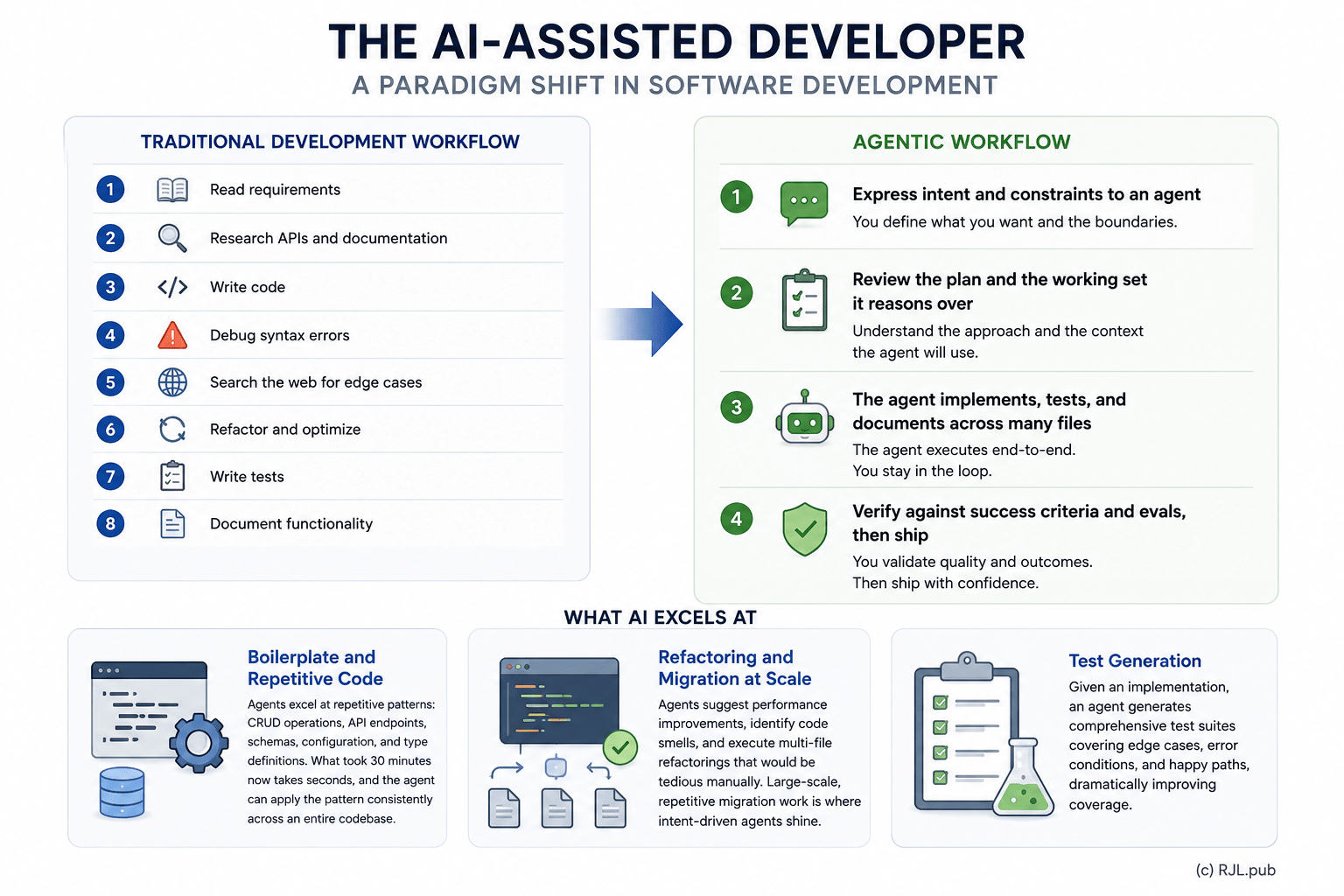
Consider the traditional development workflow:
1. Read requirements
2. Research APIs and documentation
3. Write code
4. Debug syntax errors
5. Search the web for edge cases
6. Refactor and optimize
7. Write tests
8. Document functionality
With an agentic workflow, this collapses to:
1. Express intent and constraints to an agent
2. Review the plan and the working set it reasons over
3. The agent implements, tests, and documents across many files
4. Verify against success criteria and evals, then ship
The developer focuses on intent, architecture, and quality verification. This is not laziness - it is operating at a higher level of abstraction, with accountability for the outcome.
What AI Excels At
Boilerplate and Repetitive Code
Agents excel at repetitive patterns: CRUD operations, API endpoints, schemas, configuration, and type definitions. What took 30 minutes now takes seconds, and the agent can apply the pattern consistently across an entire codebase.
Example: API Endpoint Generation
Instead of manually writing the whole thing, you describe intent and review the result:
// Prompt: "Create REST endpoints for user management following
// our service-layer pattern and existing pagination helper."
// Claude Code generates:

const express = require('express');
const router = express.Router();
const { User } = require('../models');
const { authenticateToken, validateUser } = require('../middleware');

// GET /api/users - List all users
router.get('/', authenticateToken, async (req, res) => {
  try {
    const { page = 1, limit = 10, sort = 'createdAt' } = req.query;
    const users = await User.findAll({
      limit: parseInt(limit),
      offset: (parseInt(page) - 1) * parseInt(limit),
      order: [[sort, 'DESC']],
      attributes: { exclude: ['password'] }
    });
    const total = await User.count();

    res.json({
      users,
      pagination: {
        page: parseInt(page),
        limit: parseInt(limit),
        total,
        pages: Math.ceil(total / parseInt(limit))
      }
    });
  } catch (error) {
    res.status(500).json({ error: error.message });
  }
});

// POST /api/users - Create new user
router.post('/', validateUser, async (req, res) => {
  try {
    const user = await User.create(req.body);
    res.status(201).json(user);
  } catch (error) {
    res.status(400).json({ error: error.message });
  }
});

// Additional CRUD operations...
module.exports = router;
Code Explanation and Documentation
Agents analyze complex code and generate clear explanations - invaluable for legacy systems and unfamiliar codebases. Codebase walkthrough and architecture Q&A are now standard onboarding tools.
Refactoring and Migration at Scale
Agents suggest performance improvements, identify code smells, and execute multi-file refactorings that would be tedious manually. Large-scale, repetitive migration work - the kind no team wants to staff but every business needs done - is where intent-driven agents shine.
Test Generation
Given an implementation, an agent generates comprehensive test suites covering edge cases, error conditions, and happy paths, dramatically improving coverage.
What Humans Still Do Better
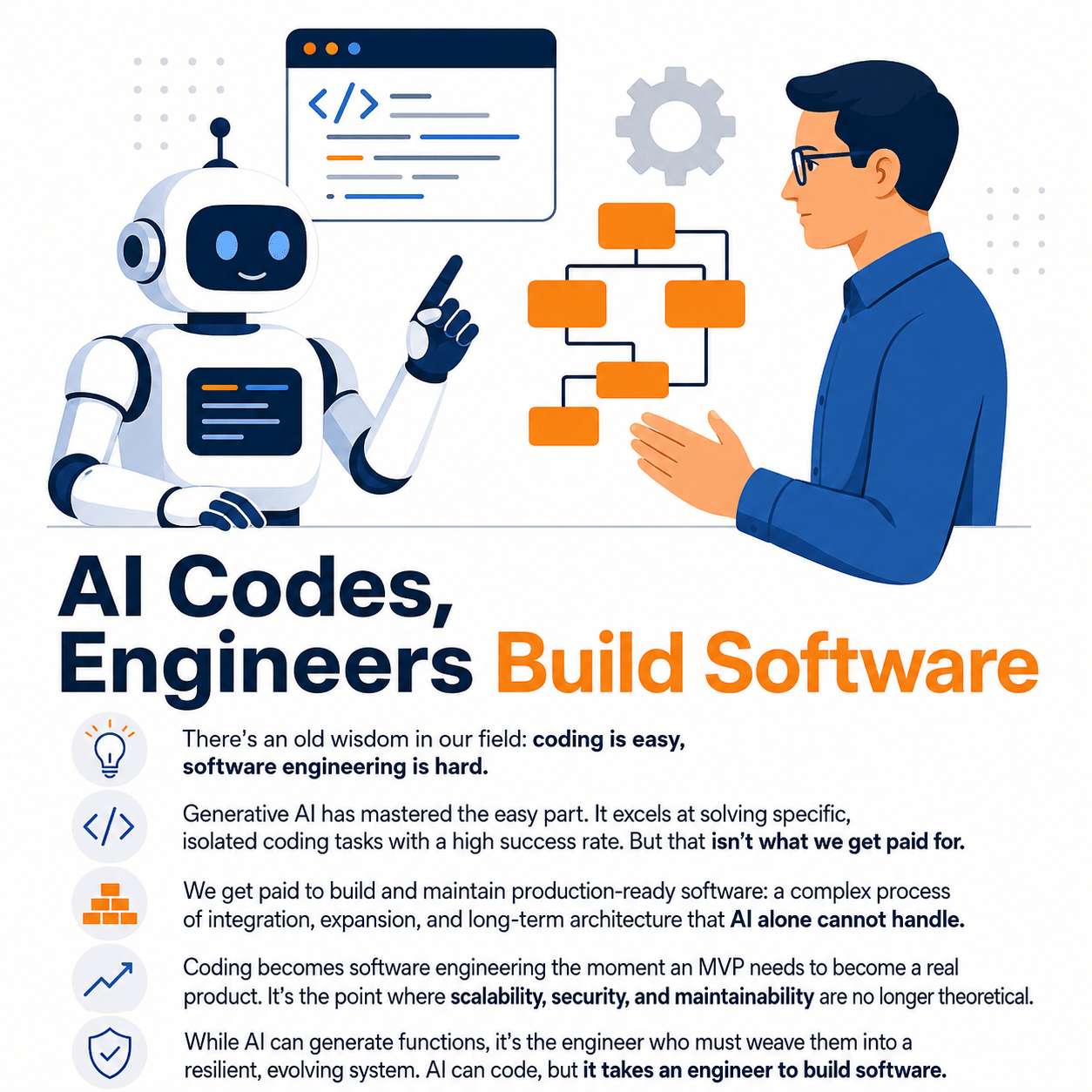
There is an old truth in this field: coding is easy, software engineering is hard. Generative AI has largely mastered the easy part - it solves specific, isolated coding tasks with a high success rate. But that is not what we are paid for. We are paid to build and maintain production-ready software: integration, scale, security, and long-term architecture that AI alone cannot own. AI can generate a function; it takes an engineer to weave those functions into a resilient, evolving system. AI codes; engineers build software.
Architecture and System Design
Agents implement components but still need human judgment on high-level architecture. Microservices vs. monolith, SQL vs. NoSQL, event-driven vs. request-response - these require business context, scale requirements, and team realities.
Business Logic and Domain Expertise
An agent follows patterns; it cannot fully own your domain. Edge cases in financial calculations, healthcare regulations, or industry workflows require human judgment.
Security and Vulnerability Assessment
Agents flag obvious issues, but they do not replace security expertise. Authentication flows, data privacy, and the new class of agent-specific risks - prompt injection, over-broad tool permissions - require human review.
Judgment About Where AI Fits
The highest-leverage call is not writing code - it is deciding where AI earns its keep and where it actively makes things worse. That judgment comes from experience, and it is what separates teams that ship with AI from teams that produce AI theater.
The New Developer Skillset
Agentic development requires new capabilities:
1. Working With Agents - directing autonomous systems like senior partners
2. Context Architecture - structuring information for optimal assistance
3. Intent Specification - defining outcomes, constraints, and stop rules
4. Rapid Verification - reviewing AI work and trusting evals over self-reports
5. Orchestration - combining models, tools, and agents effectively
These skills are learnable, and this book provides practical training in each.
The Tool Evolution
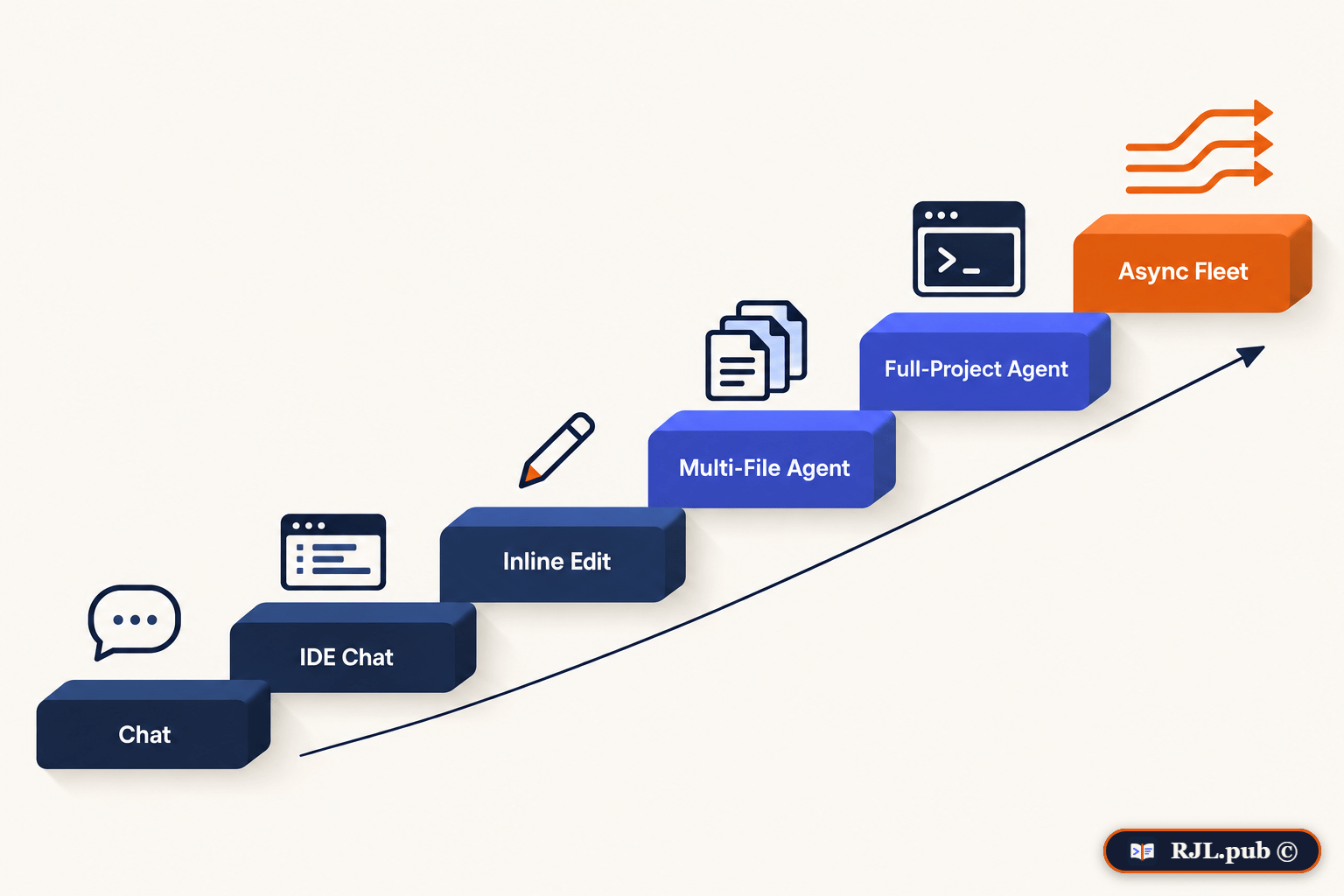
The transition to agentic development was a progression through increasingly capable stages. Understanding it frames where the industry is heading.
Stage 1: Chat-Based Assistance
It started with chat in browser tabs - copy code in, get suggestions, copy results back. Clunky but eye-opening. The model could explain algorithms, debug confusing errors, and generate boilerplate faster than you could type. Limitation: constant context switching and no file awareness.
Stage 2: IDE Chat (Ask)
Copilot's chat brought AI into the IDE. Highlight code, ask questions, no leaving the editor. Still mostly asking rather than doing.
Stage 3: Inline and Edit Mode
AI began editing files directly: "refactor this to async/await," "add error handling." Instead of integrating chat output by hand, the tool modified files in place. A substantial productivity leap.
Stage 4: Multi-File Agents
Agent modes introduced coordinated multi-file operations. "Add authentication to this API" became a single instruction that created middleware, updated routes, added migrations, generated tests, and updated docs - the first taste of true agentic behavior.
Stage 5: Terminal, IDE, and Full-Project Agents
Claude Code, OpenAI Codex, and Google Antigravity operate with full filesystem access - reading and modifying any file, running commands, understanding the whole codebase through AGENTS.md and CLAUDE.md, and integrating with CI/CD. This is the everyday driver for many engineers in 2026: describe what you want, and the agent architects, implements, tests, and documents it while you review.
Stage 6: Async, Background, and Multi-Agent Systems
The current frontier is no longer a single agent at your keyboard. It is fleets of agents running asynchronously in the cloud - you assign a task or a GitHub issue, the agent works in its own environment, and a pull request comes back for review. Codex cloud tasks, Google Jules, the GitHub Copilot coding agent, and autonomous engineers like Devin run work in parallel while you do something else. Specialized agents collaborate: one on backend, one on frontend, one on tests, one on security review. The skill shifts from writing code to specifying intent, orchestrating agents, and reviewing outcomes at scale.
We are well past the early innings. The tools improve monthly, and the developers and leaders who master each stage as it emerges maintain a compounding advantage.